
What WebMCP Means for Developers

The Agentic Web is Here: What WebMCP Means for Developers
Remember when you had to manually click through every step of a travel booking site, copy-pasting dates and personal details into form fields? That friction is about to disappear. As artificial intelligence becomes increasingly integrated into everyday browsing experiences, a new frontier is emerging—the agentic web. This evolution demands that developers rethink how websites interact not just with humans, but with intelligent agents capable of autonomously completing complex tasks. Enter WebMCP, a groundbreaking proposed web standard that promises to transform how developers create adaptive, agent-ready digital experiences.
In this article, I’ll break down What WebMCP Means for your development workflow, your architecture decisions, and the future of user interaction on the web.
Understanding WebMCP: More Than Just Another API
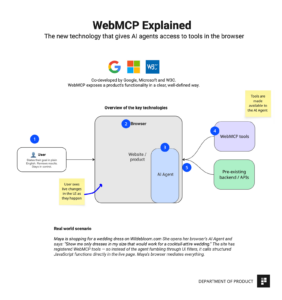
WebMCP, or Web Model Context Protocol, represents a paradigm shift in web development. Unlike traditional approaches where AI agents must interpret UI elements through fragile DOM scraping or simulated clicks, WebMCP allows websites to explicitly declare their capabilities to AI agents.
Think of it this way: instead of an agent having to figure out which button to click or what form field to fill, WebMCP enables websites to proactively say, “Here’s exactly what I can do, and here’s how you can do it.”
This is the core of What WebMCP Means for the industry—moving from guesswork to structured, reliable communication between web applications and autonomous agents. It’s like giving agents a map and a key, rather than forcing them to pick the lock.
Key Benefits of WebMCP
- Structured tool discovery: Agents receive clear, machine-readable definitions of available capabilities
- Predictable execution: Eliminates guesswork through explicit function calls with defined parameters
- Maintained human interface: Preserves the original user experience while enabling agent augmentation
Why WebMCP Matters for Modern Development
For developers who’ve spent years building applications that serve humans, the rise of agentic interactions represents both a challenge and an opportunity. To truly understand What WebMCP Means for your projects, consider the current state of AI integration.
Today, most “AI-powered” web features are essentially wrappers around API calls. An AI assistant on an e-commerce site doesn’t actually interact with the site itself—it just calls pre-built endpoints. WebMCP changes this entirely. It enables agents to navigate, interact, and complete tasks exactly as a human would, but with machine speed and precision.
For businesses, this translates to reduced friction in customer journeys, lower abandonment rates in multi-step processes, and the ability to offer genuinely intelligent assistance without rebuilding entire platforms. For developers, it means thinking about interfaces as dual-purpose—serving both human visual needs and machine-readable logic.
The Technical Foundation of WebMCP
WebMCP operates through two complementary APIs that work directly within the browser environment. Understanding both approaches is essential to grasping What WebMCP Means for your implementation strategy.

The Imperative API
Developers can use standard JavaScript to define sophisticated tools that expose application logic. This approach offers maximum flexibility and control:
await document.modelContext.registerTool({
  name: "submit_application",
  description: "Submit job application with structured candidate data",
  parameters: {
    type: "object",
    properties: {
      fullName: { type: "string" },
      email: { type: "string" },
      resumeUrl: { type: "string" }
    }
  },
  execute: async (params) => {
    // Direct application logic execution
    return { success: true, applicationId: "APP-12345" };
  }
});
The Declarative API
For simpler use cases, developers can annotate existing HTML forms directly, making it easy to add agentic capabilities to existing UI components:
<form mcp-tool="share-location"
      mcp-description="Returns the user's current office location">
  <button type="submit">Share Location</button>
</form>
This dual-approach design means you can start small with declarative annotations on existing forms and gradually adopt the imperative API for more complex agent interactions as your needs evolve.
WebMCP vs. MCP: Understanding the Distinction
A common question developers ask is whether WebMCP replaces the Model Context Protocol (MCP). The answer is nuanced: they’re complementary technologies serving different purposes.
To fully appreciate What WebMCP Means in the broader ecosystem, it’s helpful to contrast it with its server-side counterpart:
- Environment: MCP is platform-agnostic and server-side, while WebMCP is browser-specific and client-side
- Lifecycle: MCP connections are persistent (always available), whereas WebMCP tools are ephemeral (tab-bound)
- Primary Use Case: MCP excels at data retrieval and background tasks; WebMCP specializes in live UI interaction and contextual actions
- Connectivity: MCP works across desktop, mobile, and web; WebMCP is designed specifically for browser agents
While MCP provides persistent data access and backend integrations, WebMCP specializes in real-time, contextual interactions with live web applications. The most powerful agentic experiences combine both approaches—leveraging MCP for background data and WebMCP for front-end interaction.
Practical Implications for Developers
Enhanced User Experiences
WebMCP enables scenarios previously impossible or unreliable:
- Travel booking assistants that can navigate complex multi-step processes with perfect accuracy
- Customer support agents that can directly interact with help desk interfaces to resolve issues
- Job application automation that maps candidate data precisely to form fields without human intervention
These aren’t theoretical use cases—they represent the immediate practical outcomes of adopting WebMCP. When you consider What WebMCP Means for your users, think about the repetitive, multi-step tasks that currently cause friction and drop-off.
Security and Permissions
WebMCP implements robust security measures that should reassure developers and business owners alike:
- Origin isolation requirements ensure document stability
- Permissions Policy gates tool registration and execution
- Cross-origin iframes require explicit allow=”tools” attributes
Important Consideration: WebMCP tools are ephemeral—they exist only when your page is open in a browser tab. Once users navigate away or close the tab, agent access is revoked. This design maintains user privacy while ensuring contextual relevance. It’s a pragmatic approach that balances functionality with security.
Getting Started with WebMCP
While WebMCP is still an emerging standard, developers can begin exploring its capabilities today. If you’re wondering What WebMCP Means for your immediate roadmap, here’s how to start experimenting:
- Enable Chrome’s experimental flag: Navigate to chrome://flags/#enable-webmcp-testing and enable the feature
- Experiment with local development: Build prototype tools using the imperative API
- Plan integration strategies: Identify which of your existing web applications would benefit most from agentic capabilities
Browser vendors are actively developing native agentic capabilities, making now the ideal time to prepare your applications for the next wave of web interaction. The early adopters of this technology will have a significant advantage when it becomes mainstream.
Challenges and Considerations
Like any emerging technology, WebMCP comes with considerations worth evaluating. While I’m deeply optimistic about What WebMCP Means for the future of the web, it’s important to approach adoption thoughtfully.
The standard is still evolving. Browser support is limited to Chrome’s experimental flags, and the specification may change before finalization. Additionally, designing for agentic interactions requires a shift in mindset—you’re effectively building two interfaces simultaneously: one for humans and one for machines.
There’s also the question of user agency and consent. How do you ensure users understand when an agent is acting on their behalf? How do you handle edge cases where agents encounter unexpected UI states? These are solvable challenges, but they require deliberate design and testing.
The Future of Adaptive Web Experiences
WebMCP represents more than a technical specification—it’s a vision for the future of human-computer interaction. By enabling seamless collaboration between humans, websites, and AI agents, it unlocks possibilities for:
- Personalized assistance that understands context and acts accordingly
- Reduced friction in complex workflows through intelligent automation
- Enhanced accessibility by providing multiple pathways for user interaction
For developers, WebMCP isn’t just about keeping up with technological trends—it’s about positioning applications to thrive in an increasingly agentic digital ecosystem. Those who embrace this standard early will find themselves at the forefront of web innovation, creating experiences that seamlessly blend human creativity with AI efficiency.
Understanding What WebMCP Means today is about more than learning a new API. It’s about recognizing a fundamental shift in how the web works—a shift toward a more intelligent, responsive, and capable digital environment.
Ready to Experiment?
Start by identifying one key feature of your application that could benefit from agentic interaction. Whether it’s form submission, data retrieval, or complex workflow navigation, WebMCP provides the tools to make it happen reliably and securely.
The agentic web is no longer science fiction—it’s here, and WebMCP is your gateway to building the next generation of adaptive digital experiences. As browsers evolve to include built-in AI agents, developers who master these concepts will lead the charge in creating websites that truly understand and respond to user intent, whether expressed through human interaction or intelligent automation.
Want to explore how AI automation and WebMCP can transform your applications? I’ve been working at the intersection of intelligent systems and web architecture for over 17 years—let’s discuss what’s possible for your projects. Get in touch and let’s build the future of the web together.